
Start earning crypto today, no investment needed →
You can earn crypto rewards short video platforms by watching content, creating videos, or completing simple social tasks. No prior blockchain experience required, and you don't need to invest a single dollar to start. In 2026, dozens of Web3 social media apps pay users in digital tokens that have real market value, but most beginners make avoidable mistakes that cost them hours or leave tokens locked in wallets they can't access.
This guide walks you through the complete process. You'll learn what crypto-reward video apps actually are, how the payment models work, and how to set up your first wallet without getting overwhelmed by jargon. I'll show you the seven steps that work across most platforms, the five mistakes that trip up newcomers, and a realistic seven-day plan to get your first tokens. By the end, you'll understand what to expect, what to watch out for, and how to treat this as a hands-on crypto education rather than a lottery ticket.
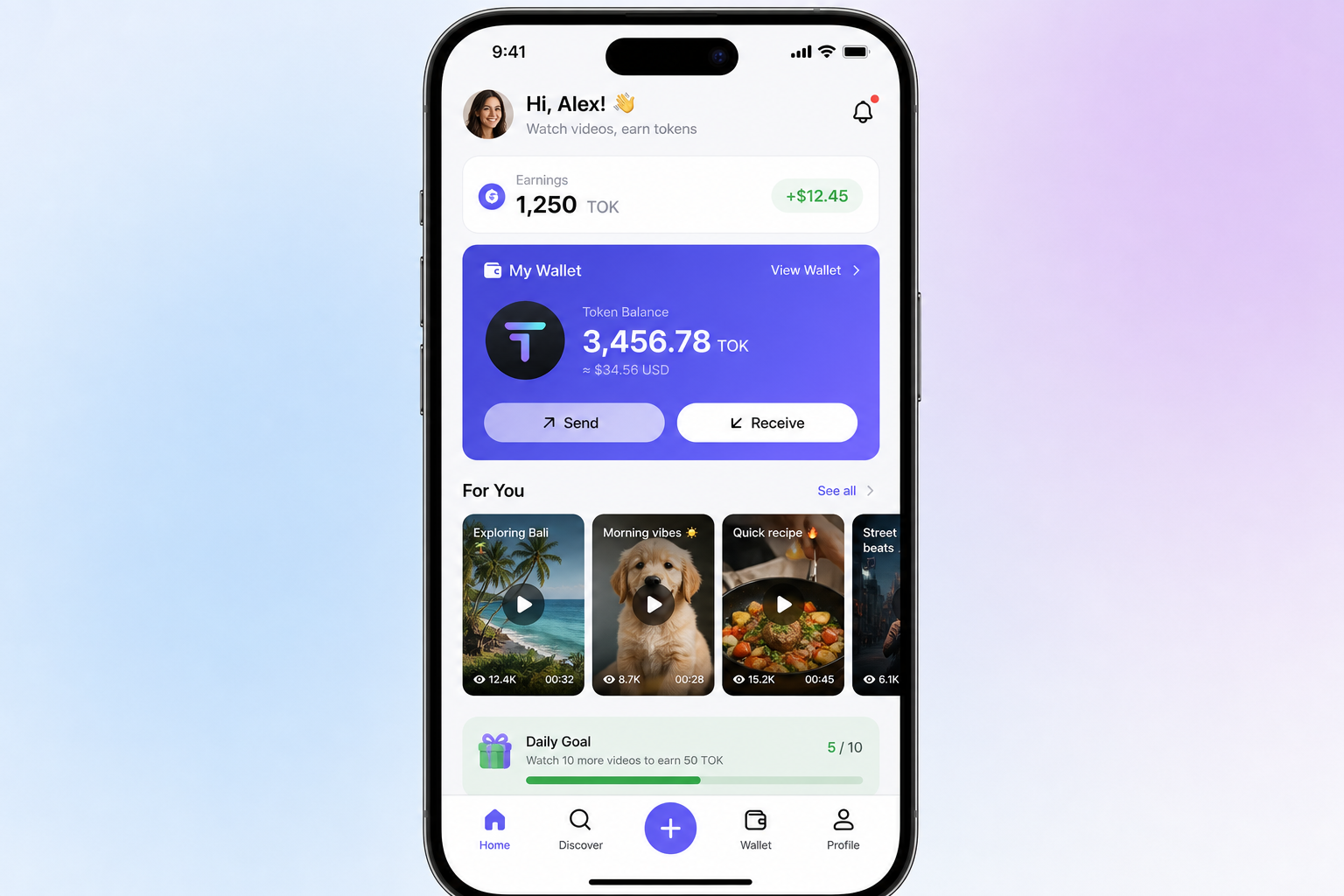
What Are Crypto-Reward Video Apps and How Do They Actually Pay You?
Crypto-reward video apps belong to a category called Web3 social media. These platforms run on blockchain technology and pay you in digital tokens instead of keeping all the ad revenue for themselves. Think of tokens as loyalty points that trade on an open market, they have a fluctuating cash value you can track in real time.
There are two main earning models. The first is watch-to-earn: you scroll through short videos, like posts, share content, or leave comments, and the app credits your account with tokens. The second is create-to-earn: you upload your own videos, and when people watch or engage with them, you earn rewards. Some platforms combine both models so you can earn whether you're a creator or just a casual viewer.
A wallet is a digital account that stores your tokens. On beginner-friendly platforms, the wallet lives inside the app itself, you activate it with a few taps, and it shows your balance in both tokens and your local currency. For example, tools like Chingari display your GARI token balance alongside its equivalent value in INR, so you always know what you've earned in familiar terms.
An airdrop is when a platform distributes free tokens to users who complete specific tasks. Chingari, a Solana-based Web3 social media app, allocated 50,000,000 $GARI tokens for users completing social and engagement tasks. These aren't random giveaways, they're designed to reward early adopters and active participants in the blockchain-based creator ecosystem.
The critical point beginners miss: token prices move up and down just like stocks. A token worth $0.40 today might be worth $0.30 next week or $0.50 next month. Your earnings are real, but they're not stable income.
Treat them as a fluctuating asset, not a paycheck. According to Wikipedia's explanation of cryptocurrency, digital tokens operate as decentralized digital currencies that use cryptography for security, meaning their value is determined by market forces rather than centralized authorities. Understanding this fundamental characteristic explains why token prices experience volatility and why blockchain basics help you navigate these platforms more effectively.
Step-by-Step: How to Start Earning Crypto on a Short Video App
Starting with a crypto-reward video platform takes about 30 minutes if you follow this sequence. Each step builds on the last, so don't skip ahead.
Step 1: Research and choose a legitimate app. Look for platforms with transparent tokenomics, that means they publish clear information about how many tokens exist and how they're distributed. Check whether the token is listed on a major exchange so you know it has real liquidity.
Verify the team behind the project is public and that the smart contract has been audited. Red flags include anonymous founders, promises of guaranteed returns, and tokens you can't find on any exchange.
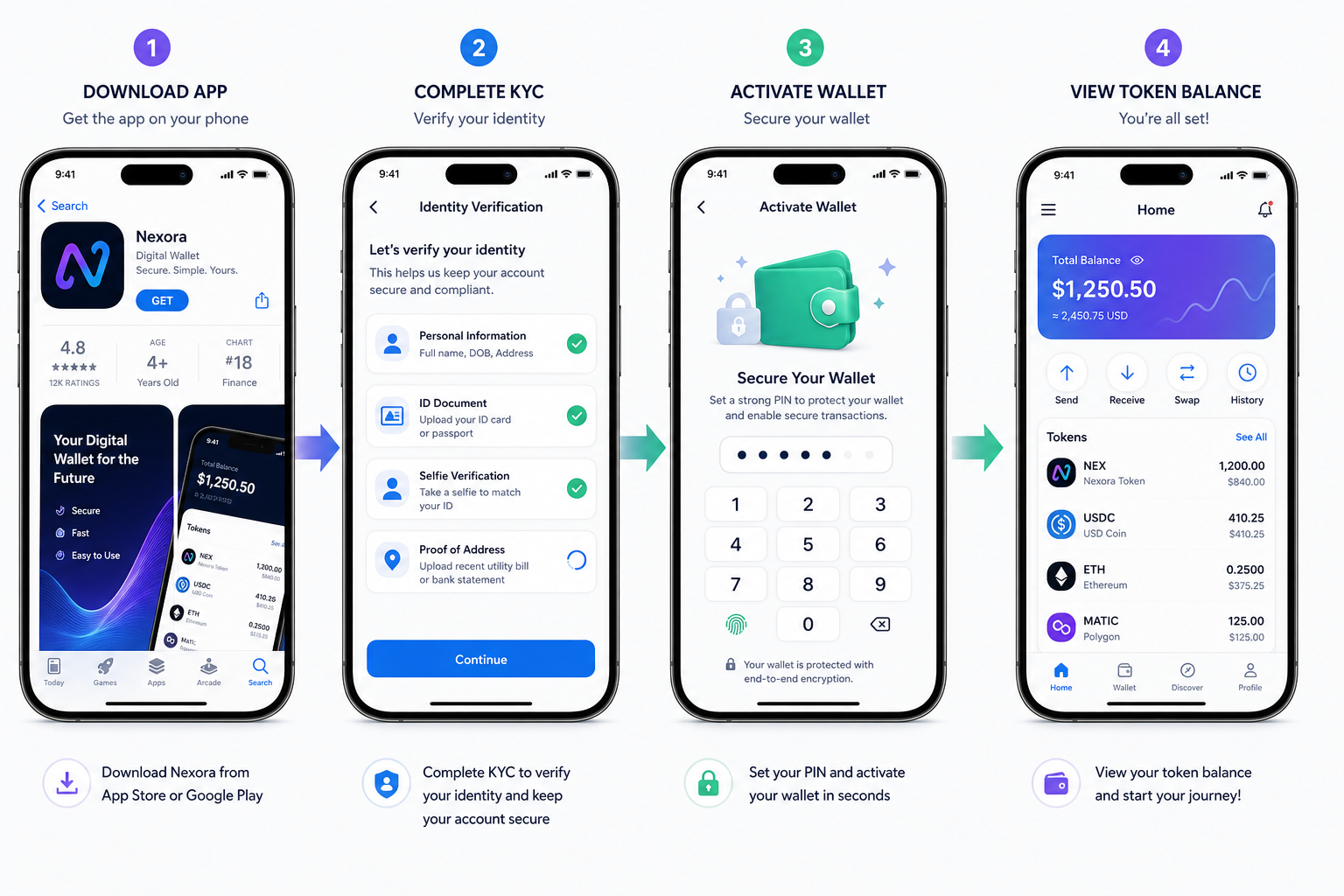
Step 2: Download the app and create an account. Visit the official website or app store listing, never download from third-party sites. Sign up with your email or phone number. Most platforms will send a verification code to confirm your identity.
Step 3: Complete identity verification (KYC). KYC stands for "know your customer," and it's a standard requirement on platforms that handle real value. You'll upload a government ID and sometimes a selfie. Many platforms process verification directly within their apps, making the experience smooth and secure.
It feels invasive if you're not used to it, but it's how these platforms comply with financial regulations. If you skip this, you'll earn tokens but won't be able to withdraw them.
Step 4: Set up or activate your in-app crypto wallet. A wallet is simply a secure digital account that holds your tokens. On beginner-friendly apps, this is a one-tap activation process, no need to manage long strings of characters or write down seed phrases yet. For instance, GARI wallet activation in the Chingari app includes INR balance display, so you see your earnings in a currency that makes sense to you.
Step 5: Learn the earning mechanics. Spend 10 minutes exploring the app. Look for sections labeled "Earn," "Tasks," or "Rewards.
Most platforms reward you for watching videos for a set duration, liking posts, sharing content to other social networks, or referring friends. Take notes on what actions pay out and how much.
Step 6: Start with low-effort tasks. Before you create content, just watch and engage. Scroll through videos, tap the like button, leave a comment, and share a video to your other social accounts if the app asks.
Low-effort tasks let you earn your first tokens with zero performance pressure. You'll also get a feel for what content performs well on the platform.
Step 7: Understand how to check your balance and withdrawal options. Navigate to your wallet section daily. You'll see your token balance and its current value.
Look for a "Withdraw" or "Convert" button. Some platforms let you transfer tokens to an external wallet or exchange immediately, while others have minimum withdrawal thresholds or require you to convert to a stablecoin first. Read the withdrawal instructions before you assume you can cash out instantly.
5 Mistakes Crypto Beginners Make with Video Reward Apps
I've watched dozens of newcomers stumble through their first crypto-reward experience. These five mistakes come up again and again, and they're all avoidable.
Mistake 1: Treating earned tokens like guaranteed income. You earn 1,000 tokens when the price is $0.40 each, and you mentally log "$400 earned." Two weeks later, the token drops to $0.15, and your balance is now worth $150.
Token prices swing based on market demand, just like stocks. If you need predictable income, this isn't the place to find it. Tokens are speculative assets.
Check the price daily and decide whether to hold or convert based on your risk tolerance.
Mistake 2: Skipping KYC and then being unable to withdraw. You watch videos for a month, accumulate tokens, and then try to cash out, only to discover you need to complete KYC first. Some platforms process KYC for Indian users directly within the Chingari app, while others route you to a third-party service.
Verification can take 24 to 48 hours. If you wait until you want to withdraw, you'll feel the wait time acutely. Complete KYC on day one, even if you're not planning to withdraw for weeks.
Mistake 3: Falling for scam apps that promise huge returns. If an app promises you $100 a day for watching 10 videos, it's a scam. Legitimate platforms pay modest amounts, think a few dollars a month for casual engagement, not rent money.
To verify an app is real, check whether the token is listed on a major exchange like Binance or Coinbase. Look up the team on LinkedIn. Search for the smart contract address on a blockchain explorer and verify it's been audited.
Walking away is the smart choice if you can't find any of this information.
Mistake 4: Not understanding vesting schedules. Vesting means tokens unlock gradually over time, not all at once. For example, some platforms offer 50% of tokens at Token Generation Event (TGE) and 50% after 12 months, or 33.3% at TGE and 66.7% after 12 months.
If you earned 1,000 tokens through an airdrop, you might only be able to access 333 of them today. Month by month, the rest unlock. Beginners see a big number in their wallet and expect to withdraw it all, then feel frustrated when the app says "locked.
Read the vesting terms before you assume all your tokens are liquid.
Mistake 5: Ignoring gas fees and minimum withdrawal thresholds. Gas fees are transaction costs on a blockchain. On some networks, moving $5 worth of tokens might cost $3 in fees, which makes small withdrawals pointless.
Minimum withdrawal thresholds exist for this reason, platforms might require you to accumulate at least $10 or $20 worth of tokens before you can withdraw. Trying to cash out $2 immediately will either hit a wall or consume most of your earnings in fees. Let your balance grow before you withdraw.
Tools and Platforms Worth Exploring
Multiple platforms let you earn crypto through short video content. Each runs on a different blockchain, pays in a different token, and has its own earning mechanics. Here's a neutral comparison so you can pick the one that fits your region and style.
Chingari is the fastest-growing Web3 social media app, powered by GARI. It runs on the Solana blockchain, which is known for low transaction fees and fast processing. You earn $GARI tokens by completing social tasks like watching videos, liking posts, sharing content, and referring friends.
Chingari also runs airdrop campaigns, 50,000,000 $GARI tokens have been allocated for users who complete engagement tasks and KYC. Inside the app, an integrated wallet displays your balance in both tokens and INR, which makes it particularly accessible for beginners in India. The IDO token price was set at $0.4, giving you a benchmark for evaluating your earnings.
TRON-based video platforms operate on the TRON blockchain and typically pay in TRX or platform-specific tokens. These apps often focus on micro-rewards for watching ads or engaging with sponsored content. TRON's advantage is near-zero gas fees, so even small withdrawals make sense.
However, TRX price volatility can be sharp, and some TRON apps have shorter track records.
Lens Protocol creators use a decentralized social graph built on Polygon. If you create content on a Lens-compatible app, you earn tokens based on follower engagement. Creators benefit more from this model than casual viewers.
Lens apps tend to have smaller user bases but more engaged communities. Posting videos and building a following makes Lens worth exploring.
Decentralized video platforms like Odysee pay in LBRY Credits (LBC) for uploading videos and earning views. Odysee skews toward longer-form content rather than short clips, so it's not a direct TikTok competitor. Beginners find the earning potential lower, but the platform has been around since 2016 and has a stable token with real liquidity.
The best platform depends on three factors: your region (some apps are geo-restricted), your content style (do you want to create or just watch?), and your risk tolerance (newer apps offer higher potential rewards but also higher risk). For absolute beginners, starting with a platform that has a large user base, clear KYC process, and local currency display, tools like Chingari, reduces friction.
Supporting tools you'll need: Download a portfolio tracker like CoinGecko or CoinMarketCap to monitor the real-time value of the tokens you earn. Signing up for a reputable exchange like Binance, Coinbase, or WazirX (for Indian users) becomes necessary if you want to convert tokens to cash. These exchanges let you sell tokens for stablecoins or fiat currency and withdraw to your bank account.
Understanding the technical infrastructure behind these platforms helps you make informed decisions. The Internet Engineering Task Force (IETF) develops standards that underpin blockchain protocols and cryptocurrency networks, ensuring interoperability and security across different systems. Familiarizing yourself with these foundational technologies, even at a basic level, enhances your ability to evaluate platform legitimacy and understand how your tokens move across networks.
What to Do This Week: Your First 7 Days Earning Crypto with Videos
Here's a realistic plan for your first week. Each day has a single focus so you don't get overwhelmed.
Day 1-2: Pick one app, download it, and complete KYC. Spend 20 minutes researching. Read this article again, check token prices on CoinGecko, and pick one platform.
Download the app from the official store. Create your account and immediately start the KYC process. Upload your ID and selfie.
While you wait for approval, watch a few tutorial videos within the app to understand the interface.
Day 3: Activate your wallet and explore the feed. Once KYC is approved, activate your in-app wallet. On Chingari, this means tapping "Activate GARI Wallet" and confirming.
Then spend 20 minutes just scrolling through videos. Watch, like, and comment. Don't worry about earning yet, just get comfortable with the app.
Check your wallet at the end of the session to see if any tokens appeared.
Day 4-5: Post your first short video. Pick something simple, a 15-second clip of your morning coffee, a quick tip about something you know well, or a reaction to a trending topic. Polished content isn't the goal here.
Understanding the creator side of the platform is what matters. Post it, share it to your other social accounts if the app incentivizes that, and check back in a few hours to see if you earned any engagement rewards.
Day 6: Check your wallet balance and compare to market prices. Open your wallet. You'll see a number of tokens and a value in your local currency.
Write down both numbers. Now open CoinGecko and search for the token by name. Compare the app's displayed value to the current market price.
Matching values mean the app is showing you accurate real-time data. If the app shows a higher value, it might be using an outdated price. Verification rather than blind trust is what this teaches you.
Day 7: Research what your earned tokens are worth and decide your next move. Calculate your hourly rate. If you spent 2 hours over the week and earned $3 worth of tokens, that's $1.50 per hour, well below minimum wage in most countries.
Normal results look like this. Crypto-reward apps are learning tools, not jobs. Decide whether you want to hold your tokens (betting the price will rise), convert them to a stablecoin (locking in the current value), or withdraw to an exchange (cashing out).
No right answer exists, it depends on your risk tolerance and goals.
At the end of week one, you'll have hands-on experience with a Web3 wallet, token transactions, and market volatility. You'll understand how to earn crypto rewards short video platforms offer, and you'll have realistic expectations about the financial upside. Learning crypto with zero investment is what this represents, not a get-rich-quick scheme.
The practical skills you develop during this first week extend beyond simple token accumulation. Building literacy in digital wallet management, understanding blockchain transaction mechanics, and developing the ability to assess token value in real-time markets all happen simultaneously. These capabilities form the foundation for more advanced Web3 participation as the technology continues to evolve and new earning opportunities emerge across different blockchain ecosystems.
Understanding the Broader Context of Crypto Rewards
Crypto-reward video apps represent a shift in how social media platforms distribute value. Traditional social networks capture all advertising revenue and engagement data, compensating users with nothing beyond the service itself. Web3 alternatives flip this model by tokenizing attention and engagement, turning every view, like, and share into a measurable unit of value that flows directly to users.
This transformation didn't happen overnight. Blockchain experiments in decentralized content publishing gave birth to the concept of tokenized social networks, dating back to platforms like Steemit in 2016. Those early attempts struggled with scalability, user experience, and token economics that couldn't sustain long-term growth.
Modern platforms in 2026 have learned from those failures. Building on faster blockchains like Solana and Polygon, they've implemented more sustainable token distribution models and created mobile-first interfaces that feel familiar to anyone who's used TikTok or Instagram. A new category of apps that actually work for mainstream users, not just crypto enthusiasts, has emerged as a result.
The economics of these platforms depend on a delicate balance. Distributing enough tokens to incentivize participation without flooding the market and crashing the token price is the challenge platforms face. They need to attract advertisers and premium users who inject actual money into the ecosystem while also rewarding free users enough to keep them engaged.
When this balance works, everyone benefits. Direct compensation flows to creators for their content without depending on opaque algorithms and demonetization policies. Viewers get paid for their attention instead of being treated as products to be sold to advertisers. Early adopters accumulate tokens that may appreciate significantly if the platform grows.
When the balance fails, token prices collapse, users lose trust, and platforms shut down. Repeated occurrences of this pattern in the crypto space explain why due diligence and realistic expectations matter so much.
The regulatory landscape adds another layer of complexity. Navigating securities laws, know-your-customer requirements, and cross-border financial regulations becomes mandatory for platforms that distribute tokens to users. KYC verification exists as a mandatory step rather than optional because these platforms aren't trying to invade your privacy, they're trying to operate legally in a highly regulated space.
Some jurisdictions have clearer frameworks than others. Treating most tokens as securities and requiring extensive compliance characterizes the United States approach. The European Union has developed the Markets in Crypto-Assets (MiCA) framework to provide regulatory clarity. India's approach has evolved from skepticism to cautious openness as the government recognizes the economic potential of blockchain technology.
For beginners, understanding these broader dynamics helps you evaluate platforms more effectively. Operating in a clear regulatory environment with transparent token economics and a sustainable business model gives a platform better long-term prospects than one promising huge returns with no visible revenue source.
Risk Management and Realistic Expectations
Before you invest significant time in crypto-reward video apps, you need a clear-eyed view of what's possible and what's not. Numbers that most platforms won't share upfront deserve discussion.
A casual user watching videos and completing basic engagement tasks typically earns between $2 and $10 worth of tokens per month. Spending 20-30 minutes daily on the platform is the assumed commitment level. Content creators with modest followings, say 1,000 to 5,000 engaged followers, might earn $20 to $50 monthly.
Top creators with viral content and large audiences can earn substantially more, think hundreds or even thousands of dollars monthly, but they're outliers. For every creator earning four figures, there are thousands earning single digits. Steepness characterizes the distribution curve.
Token value volatility amplifies everything. Earning 1,000 tokens worth $0.30 each when you received them equals $300. If the token price doubles to $0.60, you're suddenly sitting on $600.
Dropping to $0.10 shrinks your earnings to $100. Working both ways, this volatility requires strategies to manage it.
Strategy 1: Set a conversion threshold. Deciding in advance what token price will trigger you to convert to a stablecoin or cash out removes emotion from the decision. For example, "If my tokens reach $50 in value, I'll convert half to USDC and let the other half ride.
Preventing gains from evaporating while you wait for an even higher price becomes possible with this approach.
Strategy 2: Dollar-cost average your withdrawals. Instead of trying to time the market perfectly, withdraw small amounts regularly. Converting 20% of your tokens every two weeks regardless of price works well.
Smoothing out volatility and ensuring you realize some gains even if the token price trends downward over time are the benefits this strategy delivers.
Strategy 3: Treat early tokens as experiment capital. Your first tokens have high educational value but uncertain financial value. Using them to learn how to transfer between wallets, how to trade on decentralized exchanges, and how to track portfolio performance makes sense.
Counting on them to pay bills doesn't. As you develop skills and understanding, you can scale up your engagement strategically.
The psychological aspect matters as much as the financial one. Checking every hour to see if your balance has increased or decreased can make watching a token price chart compulsive. Setting boundaries for yourself protects against this.
Check prices once daily at most. Focusing your energy on creating better content or discovering platforms with stronger fundamentals rather than obsessing over short-term price movements yields better results.
Tax implications vary by country, but in most jurisdictions, token earnings count as taxable income. Calculating the taxable amount usually involves the fair market value of the tokens at the moment you receive them, not when you withdraw.
Earning 100 tokens worth $1 each means you owe tax on $100 of income even if you never sell those tokens. Keeping records of your earnings and consulting with a tax professional who understands cryptocurrency becomes necessary, generic tax advice won't cut it.
Key Takeaways
- Crypto-reward video apps pay you in digital tokens for watching, creating, or engaging with content — tokens have real but fluctuating market value.
- Complete KYC immediately so you can withdraw later; skipping this step locks your earnings.
- Vesting schedules mean you won't access all your tokens at once — some unlock over months.
- Token prices swing daily; $0.40 today could be $0.15 tomorrow, so don't treat earnings as stable income.
- Platforms like Chingari offer in-app wallets with local currency display, making them accessible for beginners who want to earn crypto without managing complex wallet software.
- Most casual users earn $2-$10 monthly; top creators with large audiences may earn substantially more, but results vary dramatically based on content quality, engagement, and token price movements.
What to do this week: Pick one platform, complete KYC, activate your wallet, and post your first video. Checking your balance daily helps you understand price volatility.
Treating this as a hands-on crypto education, not a side hustle, sets the right expectations. You're learning skills, wallet management, token trading, blockchain basics, that will serve you as Web3 grows. Start small, stay curious, and never invest more time than you can afford to lose.
The future of social media likely includes elements of token-based reward systems, even if today's specific platforms don't survive. Learning these systems now positions you ahead of the curve. Understanding how decentralized networks function, how token economics shape user behavior, and how to evaluate new platforms as they emerge becomes your competitive advantage.
This knowledge compounds over time. Transferring wallet skills from one platform to others happens naturally. Reading token charts and understanding market dynamics applies across the entire crypto ecosystem.
Managing a small token portfolio teaches risk management principles that scale to larger investments. Thinking of crypto-reward video apps as a low-stakes entry point to a technology shift that's still in its early chapters makes sense.
Whether you earn $5 or $500 this month matters less than whether you build genuine understanding of how these systems work and where they're headed.