
When chingari rizzle indian creators look at short video platforms in 2026, they're not just checking features. Money matters more than marketing promises. Here's the harsh truth: most Indian creators with 10,000-50,000 followers can't get Instagram's ₹50,000/month brand deals. YouTube's Partner Program bar of 1,000 subscribers remains out of reach for many. That leaves micro-creators with two paths: grind for years to hit these goals, or try crypto-reward platforms that pay from day one.
Both Chingari and Rizzle promise to make creator earnings fair through blockchain tokens. Token prices bounce up and down, though. Wallets confuse new users more often than platforms admit. And India's 30% crypto tax makes these platforms far more complex than they seem at first glance.
This guide cuts through the hype. We show you what Indian creators actually earn on each platform. Cashout processes get examined step by step, revealing which path truly works. And we reveal which platform truly keeps its promises in 2026 without burying creators in complexity.
The Reserve Bank of India's official position on cryptocurrencies says digital assets are legal. Strict tax rules and reporting needs apply, however. These rules hit creator earnings hard in ways most tutorials ignore. Over 23,000 Indian creators have joined Chingari's Web3 creator space since its 2021 token launch. They're building extra income streams while navigating regulations that change quarterly. They're also dealing with complex rules that demand careful attention to compliance details.
What Indian Creators Actually Need from a Short Video App with Crypto Rewards
Old-school payment systems lock creators behind huge barriers. Instagram needs 10,000 followers before you can use branded content tools, creating a two-tier system that excludes micro-influencers. YouTube demands 1,000 subscribers and 4,000 watch hours for its Partner Program. For a creator in Jaipur posting cooking videos in Hindi, that could take two years. Two years of daily uploads with zero income promised and mounting production costs that drain savings accounts.
Crypto-reward platforms flip this model. Upload a video, earn tokens right away, turn them into rupees within days. Reality is messier than the sales pitch, though. Here's a six-point system that tells real earning chances from fake promises.
Token earning rules decide how much work you do per rupee earned. Does the platform pay for video views, or does engagement drive the algorithm? Likes and comments factor in differently across platforms. Or does it just pay you to do promo tasks that have nothing to do with content quality? Chingari's airdrop model pays creators for following social media accounts. Sharing posts earns tokens, too.
That's just engagement farming. Quality takes a back seat to participation metrics. Rizzle ties rewards closer to video numbers, creating a merit-based system that favors compelling content. But it pays out far less per view, making volume essential for meaningful earnings. You need to know the actual earning system before you invest weeks of content work that might yield disappointing returns.
The core difference mirrors the broader talk in the W3C's Web Monetization standards. This group looks at how creators can get direct tiny payments without old-school middlemen taking 30-50% cuts. Indian creators need platforms with clear reward math. Not mysterious computer programs that change payouts for no reason, leaving creators guessing why their income dropped 40% month-over-month.
INR cashout path is where most platforms fail Indian creators. Earning 10,000 $GARI tokens means nothing if you can't turn them into rupees without losing half the value. Worse if you lose 40% to exchange fees and bad prices that eat away at already-modest earnings. The best setup looks like this: in-app INR balance you can see, direct UPI withdrawal, and listings on big Indian exchanges.
Think WazirX or CoinDCX. Places where you can sell tokens at fair market prices set by real supply-and-demand dynamics. Any platform that forces you through complex DeFi swaps loses you money, foreign exchanges take hidden fees from your earnings that only become apparent when rupees finally hit your account.
Content discovery computer program decides if your first 10 videos reach 500 views or 5,000 views. Instagram Reels heavily favors English content, disadvantaging the 90% of Indian creators who work in regional languages. It favors creators who already have big followings, making cold starts nearly impossible. For regional language creators, this creates a wall you can't see but definitely feel. The question for Chingari and Rizzle: does the system surface Tamil cooking videos to Tamil viewers, or does it just boost whatever's already hot regardless of linguistic and cultural relevance?
The computer program challenge hits all short-video platforms in India's language-diverse market. With 22 official languages and hundreds of regional dialects, platforms must solve tech problems, problems that English-first apps like TikTok never faced at scale or had the motivation to address properly.
Compare Platform Features Now →
KYC and rule-following splits real platforms from legal gray zones. India's 2022 crypto tax rules hit hard with implications that extend far beyond simple percentage calculations. Flat 30% tax on gains wipes out a third of earnings before you even see the money. Plus 1% TDS on every deal above ₹10,000 adds another layer of deductions. Platforms that don't report your earnings to the Income Tax Department set you up for future tax notices that arrive two years later with penalties attached. Aadhaar-linked KYC inside the app is the lowest bar for rule-following in 2026, protecting both platform and creator from regulatory scrutiny.
The Ministry of Finance has issued many updates since 2022. All crypto deals above ₹50,000 yearly must be reported under updated Income Tax Act rules. Creators working with platforms that lack proper KYC face audit risks, penalties range from ₹10,000 to ₹50,000 for not following rules, turning small earnings into massive liabilities.
Creator tools decide if you can make good content without a desktop editing program. Auto-captions eliminate hours of transcription work. Text-to-video generates B-roll automatically. Music libraries with licensed Indian tracks prevent copyright strikes.
One-tap effects polish amateur footage into professional-looking content. These are table stakes for 2026 platforms. The better the in-app tools, the less time you spend editing and more videos you can post each week to maintain algorithmic favor.
Modern mobile video editing has grown fast. Features that needed ₹30,000 desktop software in 2020 now run on ₹8,000 Android phones with 3GB RAM. The question for creators: does your chosen platform include these features built-in, or will you waste hours moving files to third-party editors that break your workflow and slow production schedules?
Community size and buzz hits your earning power hard. A platform with 50 million Indian users but 2% daily active use is far worse than one with 5 million users if 40% check that app daily. High buzz means your videos get seen by engaged audiences who actually watch, comment, and share. People comment with substance. They tip you beyond minimum thresholds. These buzz numbers generate token rewards that translate into real monthly income.
Daily active user percentages show platform health better than total download numbers. A platform claiming 100 million installs but only 2 million daily users has a 98% abandon rate, that signals poor user stickiness that limits your content's reach no matter your follower count or content quality. Network effects compound: dead platforms stay dead, while thriving ones create virtuous cycles of creator recruitment and audience growth.
The core shift: crypto rewards lower the earnings wall. Down from ₹50,000/month brand deals that require massive followings to ₹500-₹5,000/month token payouts accessible to anyone posting consistently. That's real money for students covering mobile data costs. Real money for rural creators offsetting production expenses. Real money for anyone building an audience from scratch without existing social media clout. But India's 30% tax on crypto gains means a ₹5,000 token payout becomes ₹3,500 after tax, factor that into every earnings guess to avoid disappointment when bank transfers arrive smaller than expected.
Risk protection is key for creators testing these platforms. Both Chingari and Rizzle offer free accounts requiring no payment info up front. This lets you test earning systems thoroughly, check cashout steps for hidden fees, and verify that actual rupee amounts hit your bank account before you commit serious content time to a platform that might disappoint. You can post 20 videos as a complete trial run.
Try to withdraw earnings to expose any cashout friction. Check that actual rupee amount hits your bank account within the promised timeframe. Do all this before scaling your content work and becoming dependent on a platform that may not deliver.
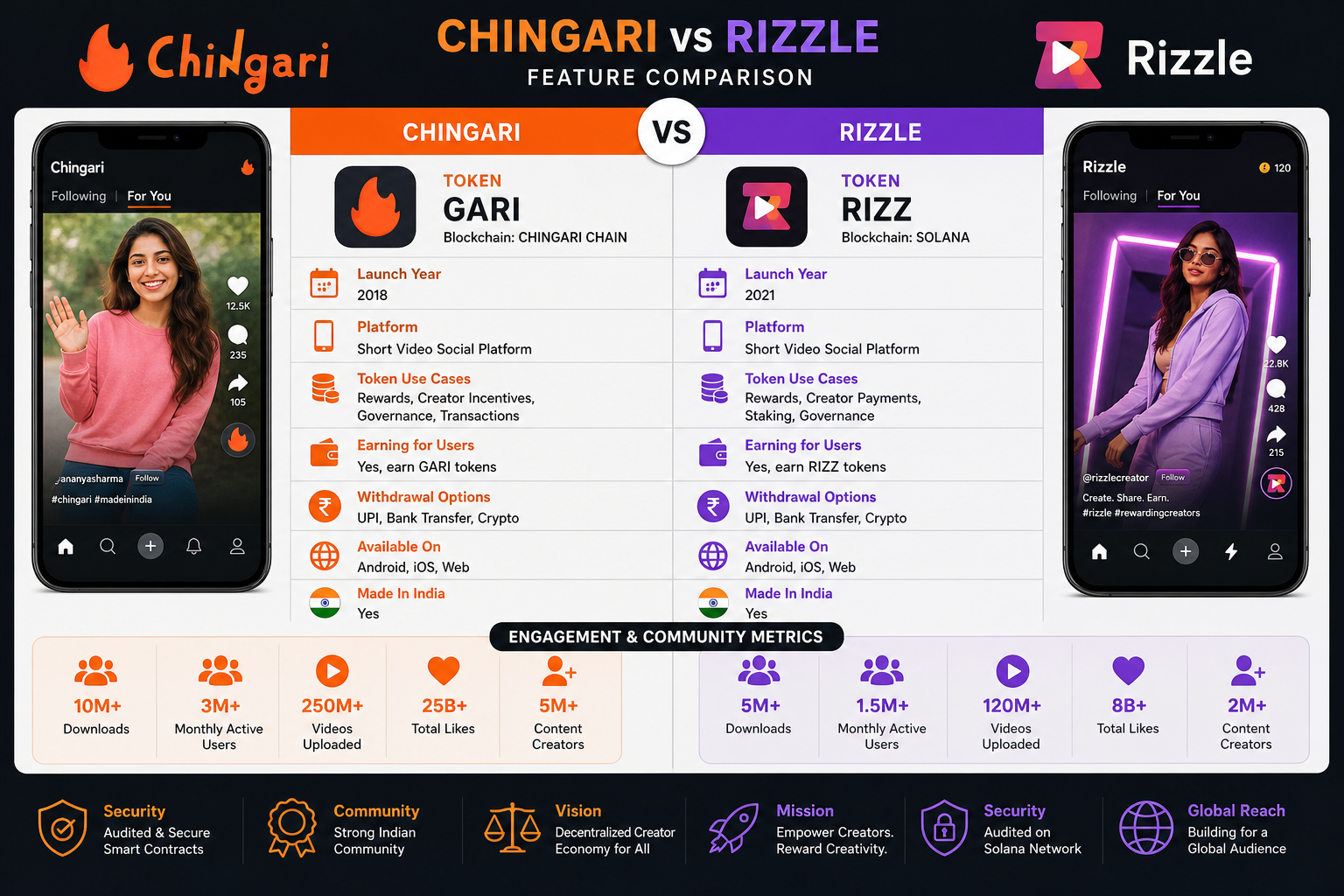
Chingari Overview: India's Homegrown Web3 Short Video Platform
Chingari launched in 2018 as India's answer to TikTok. Then the June 2020 TikTok ban created a 200-million-user hole overnight. Chingari pivoted hard into Web3, sensing opportunity in the blockchain hype. By October 2021, the platform had raised $19 million in funding from crypto-native venture firms. It launched its $GARI token at a starting price of $0.40 with ambitious promises about democratizing creator earnings.
The pitch sounded good: earn $GARI tokens for every video view without needing brand partnerships. Tip your favorite creators directly, bypassing platform commissions. Build India's first blockchain-powered creator economy where micro-influencers earn from day one. The 50 million $GARI airdrop pool for social tasks drew millions of users who completed Twitter follows, joined Telegram groups, and referred friends to claim free tokens that initially seemed valuable.
Since launching the $GARI token in November 2021, Chingari has processed over ₹45 crore in creator payouts, this went across more than 23,000 verified creators according to the platform's 2025 transparency report. This makes it India's largest Web3 creator platform by deal volume. These numbers appear in the platform's 2025 open report, showing real money flowing to Indian creators beyond theory token values that never materialize into actual purchasing power.
Strengths start with the GARI wallet, which turns on directly inside the Chingari app. Unlike platforms that force you through MetaMask or Trust Wallet with their confusing seed phrases, Chingari showed your balance in both $GARI tokens and rough INR value for instant mental accounting. This removed the biggest wall for non-crypto-native creators. You could see your earnings in rupees without needing to manually check exchange rates every time you wanted to know your actual wealth. The wallet supported fast, cheap deals since $GARI was built on Solana, avoiding Ethereum's ₹500-₹2,000 gas fees that make small transactions economically nonsensical.
The tech setup deserves credit. Solana's proof-of-stake system processes deals in 400 milliseconds with transaction fees under ₹5. This makes tiny deals make sense money-wise where Ethereum's gas fees often cost more than small creator payouts, rendering micro-transactions impossible. Chingari's choice of Solana directly enabled its creator reward model by making it economically feasible to send ₹20-₹100 payouts without fees consuming half the value.
KYC setup gave Chingari a rule-following edge. The in-app KYC process for Indian users tied accounts to Aadhaar check, meeting rule needs for crypto platforms working in India while building a verified creator database. This wasn't just about following rules, it meant Chingari could later help direct INR withdrawals and report earnings to tax people, protecting creators from future rule problems that could surface during Income Tax audits years later.
The Aadhaar setup needed partnerships with government-approved KYC providers who added secure biometric check systems that verify identity without storing sensitive data. Creators complete the process once in 3-5 minutes by scanning ID documents and completing live selfie check to prevent fraud. Once approved, the verified status enables higher deal limits while making tax reporting simpler by automatically generating Form 26AS entries that integrate with ITR filing.
Regional language support is where Chingari truly leads. The app interface supports Hindi, Tamil, Telugu, Kannada, Bengali, Marathi, Gujarati, and a dozen other languages, going beyond surface-level translation to actual linguistic accommodation. More important, the computer program surfaces regional content to regional viewers, creating linguistic echo chambers that benefit niche creators. A Bhojpuri comedy creator isn't fighting Mumbai influencers for the same audience slots, they appear in feeds of other Bhojpuri speakers who actually understand and appreciate the cultural context.
This local adaptation goes beyond interface translation. Trending hashtag sections are custom by language and region, reflecting local events and cultural moments. Search works with transliteration support, letting creators find content using English keyboard inputs for Hindi searches without switching keyboard layouts. Push alerts arrive in the creator's picked language, keeping talk consistent without forcing English literacy as a prerequisite for platform participation.
The user base gave Chingari serious scale. By mid-2022, the app claimed 130 million downloads with tens of millions of monthly active users who actually opened the app. That scale meant your videos had a real audience beyond bots and inactive accounts. Brand deals were possible for top creators who leveraged follower counts into sponsorships. Buzz rates justified the time investment for serious content creators building sustainable businesses.
But download numbers don't equal active users, a distinction that matters tremendously for actual creator reach. Industry analysis suggests daily active users peaked around 12-15 million in early 2023, roughly 9-11% of total installs. While lower than Instagram's 45-50% DAU rate, this still means a big audience base creating real earning chances for consistent creators who post daily and understand platform dynamics.
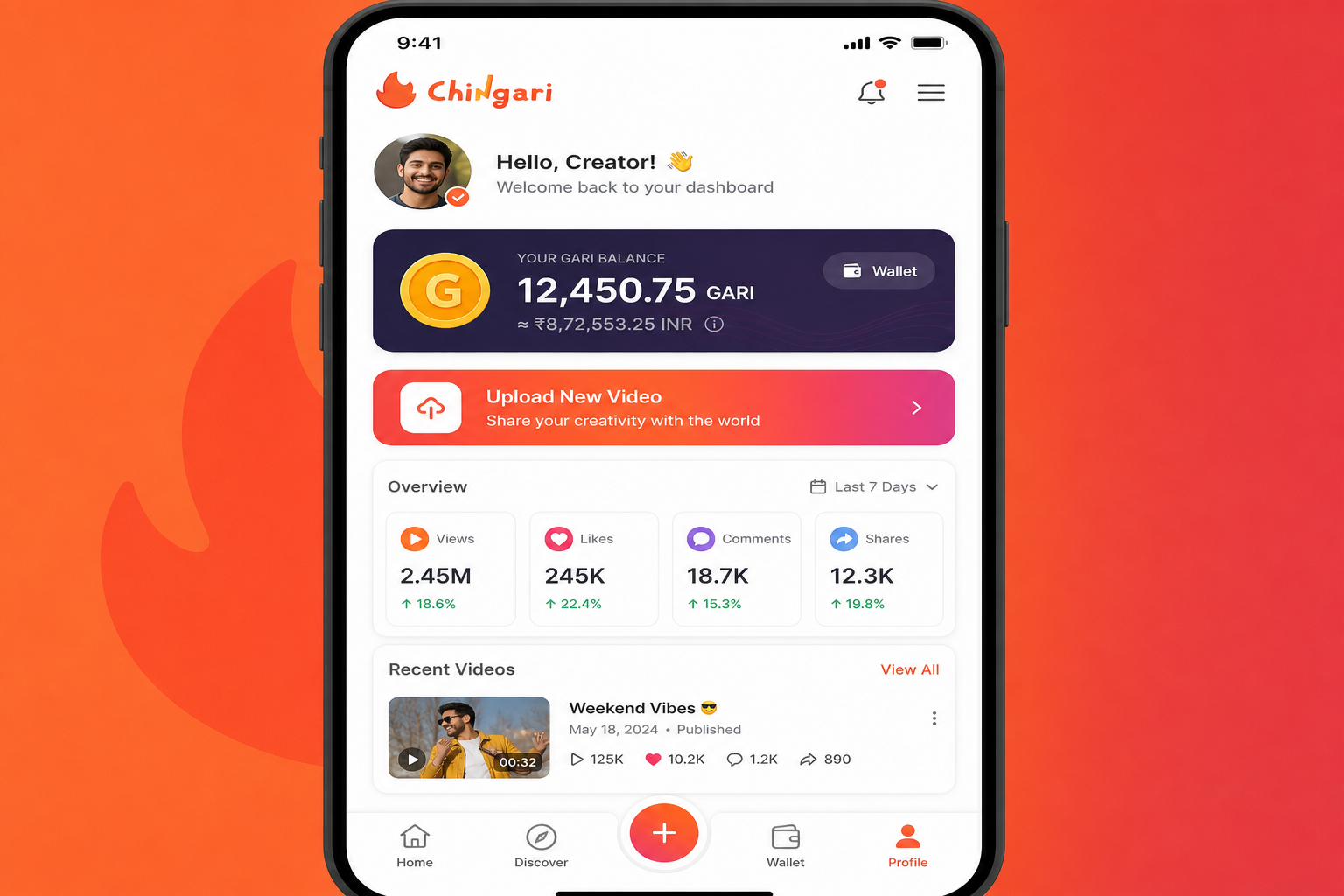
Weaknesses start with token price swings, $GARI launched at $0.80 in December 2021, crashed to $0.02 by March 2023, and currently hovers around $0.06-$0.08 depending on exchange liquidity. That 80-90% drop from IDO price means early creators who held tokens lost most of their earnings to market volatility. The lesson: turn tokens into INR right away unless you're betting on price growth that historical data suggests is unlikely.
Crypto price swings aren't unique to $GARI. Bitcoin has seen 70-80% crashes many times throughout its history. Ethereum dropped 94% during the 2018 bear market when ICO hype collapsed. Most altcoins lose 90%+ of their value within 18 months of launch, making long-term holding a speculative gamble. The broader lesson for creators: treat token rewards as income to turn into cash now, not investment assets to hold long-term in hopes of future appreciation.
Earning power per video stays modest for small creators. A video with 10,000 views might earn 50-100 $GARI tokens, that's ₹20-₹50 at current prices of $0.06 per token. At 20 videos per month, that's ₹400-₹1,000/month before the 30% crypto tax cuts into actual take-home pay. Not life-changing income. But real extra income for students and rural creators supplementing other revenue streams rather than replacing full-time employment.
To put these numbers in context: ₹1,000/month covers mobile data costs and basic editing software bills for most creators. For a college student in Nagpur or Lucknow, this offsets content creation costs while building an audience for future monetization. It's not job replacement income by any measure. But it's real money that arrives monthly, not theory future brand deals that require 100,000+ followers to materialize into actual offers.
Content quality is mixed. The airdrop-for-tasks model pushes users to spam low-effort content as they complete social media follows and farm likes rather than create good videos that require thought and production value. Scroll through Chingari's trending feed and you'll see recycled TikTok clips, awkward lip-syncs, and promo posts mixed with truly creative content that deserves better algorithmic treatment. The signal-to-noise ratio is lower than Instagram Reels, forcing viewers to scroll past garbage to find gems.
The platform has tried to fix quality problems through creator tier systems and bonus pools based on performance metrics. Top creators who keep buzz rates above 5% qualify for multiplier bonuses. Creators who post original content daily qualify for consistency rewards. These multiplier bonuses can double or triple base token rewards. But these top tiers stay available only to the top 5-10% of creators, leaving most participants with baseline earning rates.
Editing tools lag rivals. Chingari's in-app editor offers basic filters, text overlays, and speed controls that feel dated compared to 2026 standards. But it lacks the AI-powered features that define modern content creation, no auto-captions mean manual text entry for accessibility, no text-to-video eliminates B-roll generation, and no smart templates force creators to build every video from scratch. Serious creators export to CapCut or VN Video Editor before uploading to Chingari, adding 10-15 minutes per video to their workflow.
The tech gap is real. CapCut's AI speech recognition creates 95%+ accurate captions in 45 seconds flat. Chingari's manual text overlay needs 8-10 minutes per video as creators type, position, and time text elements. For creators posting daily, that's 4-5 hours of extra editing time monthly, time that could create three extra videos on rival platforms with better built-in tools.
The airdrop model created twisted pushes. Instead of rewarding content quality, Chingari paid users to complete promo tasks like following Twitter accounts, joining Telegram groups, and referring five friends to boost vanity metrics. This drew airdrop hunters who completed tasks, dumped tokens immediately, and never posted a single video worth watching. The 50 million token airdrop pool watered down early creator earnings while pushing down token price through constant sell pressure.
Airdrop farming became a small industry. Groups on Telegram planned mass account creation using virtual phone numbers for verification. They automated task completion to get max tokens with minimal effort. By some guesses, 30-40% of claimed airdrop tokens went to farmers rather than real creators, watering down rewards and hurting token value through mercenary participation that added no long-term platform value.
The honest take: Chingari built great setup for Indian crypto creators. In-app wallets eliminate external wallet complexity. Aadhaar KYC ensures regulatory compliance. Regional language support serves non-English creators. INR balance display provides instant mental accounting. But token economics and content quality haven't kept pace with the tech foundation, creating a platform that excels at rule-following and cashout systems while struggling to keep creator buzz and token value stable over multi-year timescales.
Rizzle Overview: AI-Powered Short Videos with Token Pushes
Rizzle launched from Hyderabad in 2020 with a different angle: AI-helped video creation that lowered production barriers for non-technical creators. The platform's text-to-video engine let creators type a script, select a template, and auto-create a 30-second video with B-roll, captions, and background music in under five minutes. Think of it as Canva for short-form video, democratizing production quality previously requiring expensive software and technical expertise.
The token reward system came later as crypto hype peaked. Rizzle pivoted toward Web3 in 2023, recognizing that creator earnings remained the unsolved problem in short-form video. Unlike Chingari's standalone $GARI token, Rizzle worked with existing Web3 wallets and spread rewards through a creator fund model similar to TikTok's centralized pool approach.
The platform has gained ground among tech-savvy creators and English-speaking urban viewers who appreciate polish over raw reach. While exact user numbers stay private, app data suggests 5-8 million Indian installs with about 400,000-600,000 daily active users. This means a healthier 8-10% DAU-to-install ratio than Chingari's numbers, suggesting better user retention and engagement quality even if absolute scale remains smaller.
Strengths begin with AI editing tools that truly lower production walls. Auto-captions display in many languages including Hindi, Tamil, and Telugu with 85%+ accuracy. Text-to-video creates stock footage clips that match your script automatically. Smart templates provide pre-designed intro/outro sequences with one-tap custom options. For creators without desktop editing skills, these tools change everything by making professional-quality output accessible via smartphone alone.
The AI caption engine uses speech recognition models trained on Indian English accents and major regional languages through partnerships with local AI research labs. Accuracy rates top 85% for clear audio in Hindi, Tamil, Telugu, and English, matching pro transcription services that charge ₹100-₹150 per minute of audio. By killing this cost and time wall, Rizzle makes pro-quality captions available to every creator regardless of budget constraints.
Text-to-video features use licensed stock footage databases containing over 2 million clips from Pexels, Pixabay, and Storyblocks. Type "Mumbai traffic" and the engine surfaces relevant B-roll automatically based on semantic understanding. This feature alone saves creators 15-20 minutes per video, time previously spent searching stock sites for copyright-free footage that matches narration context.
The UI/UX is cleaner than Chingari's cluttered interface. Rizzle's interface feels like a modern consumer app with easy navigation, fast loading, and little clutter that confuses users. The content feed curates higher-quality videos compared to Chingari's unfiltered chaos. Scrolling through Rizzle feels closer to Instagram Reels than a crypto test plagued by low-effort spam.
Interface design hits creator stickiness dramatically. Rizzle's 30-day creator stickiness rate sits around 35-40%, meaning creators who post their first video have a 40% chance of posting again a month later. Chingari's stickiness has dropped to 18-22% as airdrop pushes faded. Better UX directly links with sustained creator buzz, turning one-time posters into regular contributors who build audiences over months.
The creator fund spreads token rewards based on video results like views, watch time, buzz, and content quality scores determined algorithmically. This ties earnings directly to content value rather than social media task completion. Top videos can earn 500-2,000 tokens monthly with exact rates bouncing based on fund size and creator competition for finite pool resources.
The fund runs on a pool model where Rizzle sets a fixed token budget monthly, amounts stay private but reportedly range from 2-5 million tokens. Then it spreads tokens proportionally based on each creator's share of platform buzz. Earn 5% of total platform views, you get roughly 5% of the monthly token budget. This creates competition among creators but ensures rewards scale with platform growth rather than inflating supply recklessly.
Web3 wallet setup supports MetaMask, Trust Wallet, and Phantom, giving creators flexibility in how they manage tokens. For users already comfortable with crypto wallets, this is more handy than Chingari's closed system, creators keep control of tokens right away upon earning them rather than holding them in platform-controlled wallets that create custodial risk and withdrawal friction.
But this flexibility comes with safety tradeoffs. Creators must protect their own seed phrases and private keys through secure storage practices. Lost wallet login details mean forever lost earnings with zero recovery option, a risk killed by Chingari's custodial wallet model where account recovery through email/phone remains possible if credentials are forgotten.
Weaknesses start with user base size. Rizzle's Indian user count sits around 5-10 million, a fraction of Chingari's reach that limits viral potential. Fewer users means fewer views per video and lower buzz rates even for quality content. Less bargaining power for brand deals since sponsors care about reach. You're creating content for a niche audience, not a mass market with viral potential.
The network effect is brutal for social platforms. A creator with 5,000 followers on a 10-million-user platform reaches 0.05% of the available audience versus 0.0038% on a 130-million-user platform. But they benefit from stronger viral systems and recommendation algorithms trained on larger datasets that understand content patterns better. Smaller platforms struggle with cold-start algorithmic problems where insufficient data makes recommendations mediocre.
Token money supply is limited. Rizzle's reward tokens aren't listed on major Indian exchanges like WazirX or CoinDCX. Turning earnings to INR needs swapping through decentralized exchanges, bridging to Ethereum or Polygon networks, then selling on foreign exchanges, a process that eats 15-25% in fees and bad prices. This makes Rizzle's tokens work less like money than Chingari's $GARI, which trades on multiple Indian platforms with rupee pairs.
The multi-step turn process adds failure points at every stage. Decentralized exchange swaps can fail due to insufficient money supply during low-volume periods. Bridge deals sometimes get stuck requiring manual help from Discord support channels. Foreign exchange withdrawals to Indian bank accounts trigger extra rule checks under FEMA regulations. Each step adds 1-3 days of delay plus 3-7% in fees that compound into significant value loss.
Regional language support exists but feels less built than Chingari's full approach. The interface supports Hindi and a handful of other languages through basic translation. But the computer program doesn't surface regional content as well algorithmically. Tamil creators report that their videos get pushed to Hindi-speaking viewers who don't engage, watering down buzz metrics and limiting organic reach within their actual target demographic.
The computer program difference reflects training data available for recommendation models. Chingari's larger regional-language user base creates more buzz signals for Tamil, Telugu, and Kannada content, allowing better recommendation models to emerge. Rizzle's smaller dataset pushes recommendations toward Hindi and English content where signal density is higher, inadvertently disadvantaging regional creators through data poverty rather than intentional bias.
Earning amounts are lower than Chingari's for equal reach. A 10,000-view video on Rizzle might earn 30-50 tokens worth ₹15-₹35 at current token values. At 20 videos/month, that's ₹300-₹700 before tax, the AI tools are impressive but don't make up for reduced earning power. The time savings from editing tools must be weighed against lower absolute income to determine true economic value.
The earning gap adds up over time in ways that become significant for creators treating platforms as income sources. A creator posting 20 videos monthly for six months earns ₹1,800-₹4,200 on Rizzle versus ₹6,600-₹18,000 on Chingari before taxes and fees. Even accounting for time saved through AI editing tools, the net income difference ranges from 3x to 5x in Chingari's favor, a gap that matters when covering real expenses like equipment upgrades and data costs.
Finding for new creators stays a challenge. Rizzle's curated feed favors known creators with proven buzz over unknown accounts. New accounts struggle to break through the computer program bar that triggers broader spread beyond initial follower circles. Chingari's chaos oddly gives unknown creators more chances to go viral through random algorithmic selection that occasionally surfaces undiscovered gems.
New creator onboarding systems differ a lot between platforms. Chingari gives first-time creators a 72-hour "new account boost" that pushes initial videos to 2,000-5,000 feeds automatically to test content resonance. Rizzle provides no such boost, requiring organic growth from zero followers. For creators without existing audiences on other platforms, this initial spread matters tremendously, cold starts on Rizzle can take months to gain traction where Chingari provides immediate feedback.
The fair take: Rizzle built the better product for content quality and editing speed that saves hours weekly. But it's further behind in crypto setup, INR cashout paths, and the user scale that makes token rewards mean something financially. The platform serves creators who value production tools over earning power, a good choice for those building portfolios or testing content ideas before scaling on larger platforms with better monetization but worse creation tools.
The platform's "no payment needed" policy covers all features including AI editing tools and template libraries. You can create and post unlimited videos without entering credit card info, allowing complete check of earning systems before you commit serious production time to a platform that might disappoint financially even if it excels creatively.
Feature-by-Feature Comparison: Chingari vs Rizzle for Indian Creators
(1) Token Earning Power
Chingari offers many earning streams that diversify income beyond pure content performance. The 50 million $GARI airdrop pool pays users for completing social buzz tasks like following official accounts, sharing posts, and referring friends to create network effects. Content creators earn extra $GARI based on video views and buzz at roughly 5-10 $GARI per 1,000 views depending on engagement quality. Tipping lets fans send $GARI directly to creators, though tipping volume stays low outside top-tier influencers with devoted fanbases.
The multi-stream model provides earning spread that stabilizes income. On days when video views do poorly, airdrop task completion keeps baseline income flowing. Creators who build buzzing communities benefit from tipping, which can add 10-20% to monthly earnings for accounts above 50,000 followers with strong parasocial relationships.
Real monthly earnings for a creator with 10,000-50,000 followers posting 20 videos: ₹800-₹2,500 from video reward plus ₹200-₹500 from airdrop task completion. Total: ₹1,000-₹3,000/month at current $GARI prices around $0.06, assuming you turn tokens to INR right away rather than holding through price swings that could destroy value.
These guesses match self-reported creator earnings shared in Chingari creator community groups on Telegram and Discord. Mid-tier creators (15,000-30,000 followers) consistently report ₹1,200-₹2,800 monthly payouts across three-month rolling averages. Nano-creators (1,000-5,000 followers) earn ₹200-₹600 monthly. Top-tier creators (100,000+ followers) report ₹8,000-₹25,000 monthly from combined token rewards and brand sponsorships negotiated independently.
Rizzle's creator fund spreads tokens based on video results determined by computer programs that weigh multiple signals. High-doing videos earn 50-100 tokens per 10,000 views depending on watch time and engagement depth. The fund size bounces monthly based on platform performance and token price, so per-video payouts aren't promised, creating income uncertainty that makes financial planning difficult.
Real monthly earnings for the same creator profile: ₹500-₹1,200 from creator fund spreads with no airdrop tasks or tipping streams to add to video rewards. The simplified earning model makes income more predictable per video but caps total monthly earnings at lower absolute levels than Chingari's diversified streams.
The creator fund's bounce adds income guesswork that complicates budgeting. Months when the fund is large or creator competition is low can yield 40-50% higher payouts unexpectedly. On the flip side, viral content from large creators can absorb too much of fund percentages, reducing payouts for smaller accounts. This makes Rizzle earnings harder to predict compared to Chingari's more stable per-view rates, though month-to-month variance rarely exceeds 25-30%.
Winner: Chingari for raw earning power. The mix of video rewards, airdrop tasks, and tipping creates higher monthly INR equals that matter for creators treating platforms as income sources. But Rizzle's results-based model better rewards content quality over buzz farming, creating merit-based distribution that favors creative excellence over engagement gaming.
The earning gap matters most for creators treating platforms as primary income sources rather than supplementary side hustles. For extra income seekers, Rizzle's simpler time-to-payout ratio (no airdrop tasks needed) might offset lower absolute earnings. Think about your time value carefully: if you earn ₹300/hour from other work, spending 10 hours monthly on airdrop tasks to earn an extra ₹600 represents negative money value since opportunity cost exceeds nominal earnings.
(2) INR Cashout
Chingari's GARI wallet shows your token balance and rough INR value right in the app for instant mental accounting. Turning $GARI to rupees needs moving tokens to an Indian exchange like WazirX, CoinDCX, or ZebPay, all list $GARI trading pairs with reasonable liquidity. Sell $GARI for USDT or INR through market or limit orders, then withdraw to your bank account via UPI or IMPS within standard banking hours. Total process takes 2-3 days including settlement periods, with 2-4% in exchange fees plus 1% TDS on deals above ₹10,000 as required by Indian tax law.
The setup with major Indian exchanges provides fair pricing through order-book money supply that reflects true market demand. During high-volume times (morning trading hours), gaps between bid and ask prices tighten to 0.5-1%, lowering bad prices for market orders. During low-volume times (late night, weekends), gaps can widen to 3-5%, making market-order turns more costly than limit orders left to fill overnight when liquidity improves.
The Aadhaar-linked KYC process within Chingari meets Indian rule standards under PMLA regulations. Your token earnings tie to your verified identity through cryptographic signatures, making tax reporting cleaner when filing annual returns. You'll get 1% TDS cuts on withdrawals automatically reported in Form 26AS, which can be claimed against your 30% crypto tax bill to avoid double taxation.
Tax reporting rule-following becomes key during Income Tax Return filing under ITR-2 schedules. Platforms that auto-create Form 26AS entries (showing TDS cut) make the capital gains schedule simpler by pre-populating transaction data.